Sand Dollar FAQsWHAT IS A SAND DOLLAR?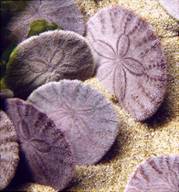
A sand dollar is a small disc-shaped marine animal closely related to the sea urchin. They are from the class of marine animals known as Echinoids, spiny skinned creatures. Their relations include sea urchins, star fish, sea lilies and sea cucumbers. When alive it is covered in a purplish suit of moveable spines that encompass the entire shell. Like its close relative the sea urchin, the sand dollar has five sets of pores arranged petal pattern. In this particular species the petal pattern is off center, hence the name "Eccentric" or " ecentricus " which happens to be an especially suitable title for a great many things found in Venice Beach. 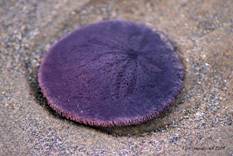 Venice Beach Sand " Bucks " are from the species Dendraster excentricus also known as the Pacific sand dollar, Western Sand Dollar or Eccentric sand dollar.
The name "sand dollar" comes from its the shape of its body which takes on a large, coin-like appearance. Besides Sand " Bucks " other names for the sand dollar around the world include sand-cake and cake-urchin. In Spanish the sand dollar is know as a galleta de mar or sea cookie. In South Africa, they are referred to as pansy shells from the five-petaled pansy flower. 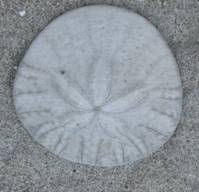
The fragile disk that is found on sandy beaches is actually the skeleton or "test" of a marine animal. By the time the test washes up on the beach it is missing its velvety covering of minute spines and appears somewhat bleached from the sun. Back to topWHERE DO SAND DOLLARS LIVE?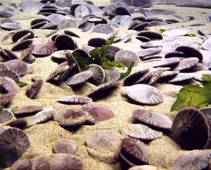
Sand dollars live on the sandy ocean floor beyond mean low water on top of or just beneath the surface of sandy or muddy areas. The spines on the somewhat flattened underside of the animal allow it to burrow or to slowly creep through the sand. On the bottom of ocean large groups of sand dollars are frequently found together. This is due in part to their preference of soft bottom areas as well as convenience for reproduction The species Dendraster excentricus is found along shore of the Northeastern Pacific as far north as Alaska and as far south as Baja California. Back to topHOW SAND DOLLARS EAT?Much like the other animals in its class (Echinoid), the under side of the creature is where the mouth is located. Protecting the mouth and the entire body are tiny spines that aid the animal in capturing food. Sand dollars may lie flat on the sand or they may partly bury themselves in sand at an angle which allows them to easily catch food. 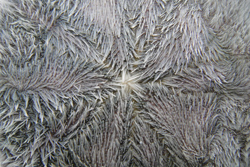
Sand dollars are considered suspension feeder and their food consists of plankton and organic particles that end up in the sandy bottom. Fine, hair-like cilia cover the tiny spines. Together with the tube feet and pedicellaria (tiny pincers) on both sides of the body they help in the complex capture, transport and sorting of food items. 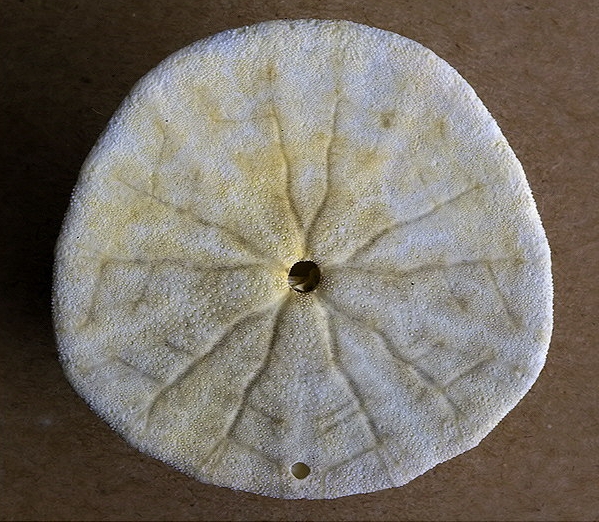
The cilia, in combination with a mucous coating, move food to the mouth opening which is in the center of the star shaped grooves on the underside of the animal. Larger suspended particles may be held by sucker-tipped podia and transported to the food grooves. For living prey such as crustacean larvae and small copepods, the spines on the oral side converge and enclose it into a little tent-like cone, where it is passed to a food groove by the jaws of the pedicellariae. 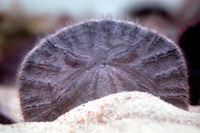
Sand is ingested with the food and it is thought that this is deliberately done by juveniles to act as weight for stability in the sand. The eccentricity of this type of sand dollar allows it to bury itself standing obliquely in the sand. 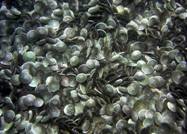
Their feeding position has been observed to be parallel to the surge current with the anterior end buried. By positioning themselves closely together, they may be exploiting their hydrodynamic shape and influencing the current flow past their bodies. Some scientists believe that this is the reason they form densely packed beds of several hundred individuals per square meter. 
A five-toothed apparatus called Aristotle's lantern chews up the food. When a dead sand dollar found on the beach is broken, white pieces that are in the shape of doves can be found inside. These "doves" were once the sand dollars teeth. Back to topWHAT IS THE FLOWER LIKE PATTERN SEEN ON THE SAND DOLLAR?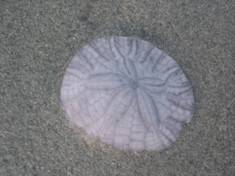
On the upper, convex surface of the sand dollar test is a flower-like pattern with five "petals". These are 5 groups of pore pairs through which the tube feet protrude and where specialized tube feet perform gas exchange. The pores are used to move sea water into its internal water-vascular system, which allows the creature to move At the center is a perforated platelike structure that forms the intake for their water-vascular system, and adjacent to this are the genital pores. Back to topHOW DO THEY REPRODUCE AND GROW?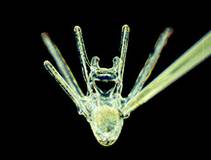
The sexes are separate and gametes are released through their pores into the water column as in most echinoids. In southern California this happens between May through July. The free-swimming larvae metamorphose through several stages during which they eventually develop 8 arms. Scientists have recently discoved that the larvae are able to clone themselves as an adaptation to enhance their survival. It is believed that the larvae receive a chemical cue from adults to settle down in a bed of sand dollars at which time the test begins to form and they become bottom dwellers. Scientists can age a sand dollar by counting the growth rings on the plates of the exoskeleton. Sand dollars usually live 6 to 10 years. The ones found in Venice beach commonly reach a size of about 3 inches in diameter. Back to topDO SAND DOLLARS LIVE ON THE BEACH?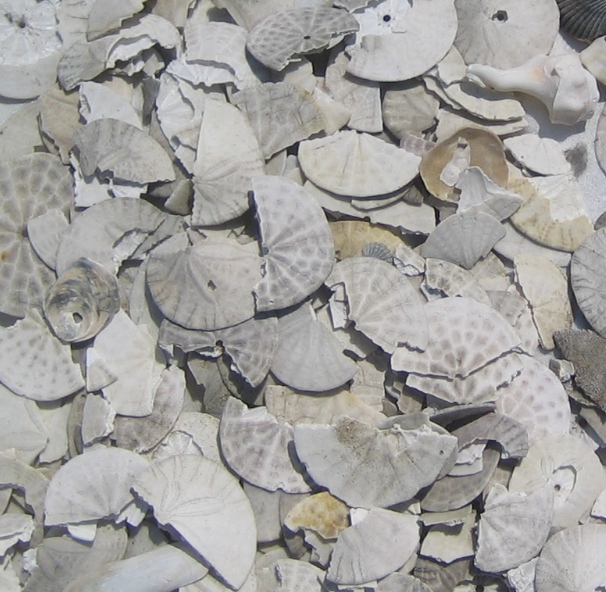
Actually, a sand dollar is unable to live on the beach. Most sand dollars live in shallow coastal waters. Sand dollars that people often find washed up on the shore are the skeletons of dead animals. Its easy to tell that they are dead because there are no spines or tube feet on a sand dollar skeleton. Often the tests of those found on the beach are broken into pieces. Back to topWHAT ARE THEIR PREDATORS?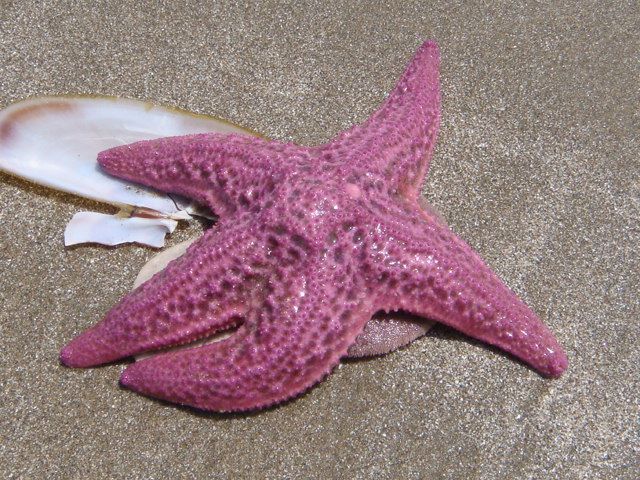
Starfish, sheepheads, flounders and snails are among those prey on sand dollars. When threatened by starfish, sand dollars bury themselves under the sand. Observers have seen a large pink sea star leave a wide path of buried sand dollars as it moves across a densely populated sand dollar bed. Back to topWHAT IS THE LEGEND OF THE SAND DOLLAR?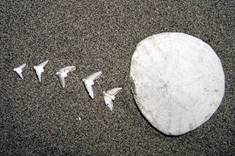
Christians have found symbols in the form and appearance of the sand sollar. It is said that Christ left the sand dollar as a symbol to help teach the faith. The five holes commemorate the five wounds of Christ, while at the center on one side blooms the Easter lily, and at the lily's heart is the star of Bethlehem. The Christmas poinsettia is etched on the other side, a reminder of Christ's birth. According to this legend, if you break the center five white doves will be released to spread good will and peace. Back to topSTILL WANT TO SEE MORE?Check out this cool time lapse video of a sand dollarBack to top |
Venice Beach Sand "Bucks"
Venice Beach Sand "Bucks" © 2011 All Rights Reserved email: venice.beach.sand.bucks@gmail.com